
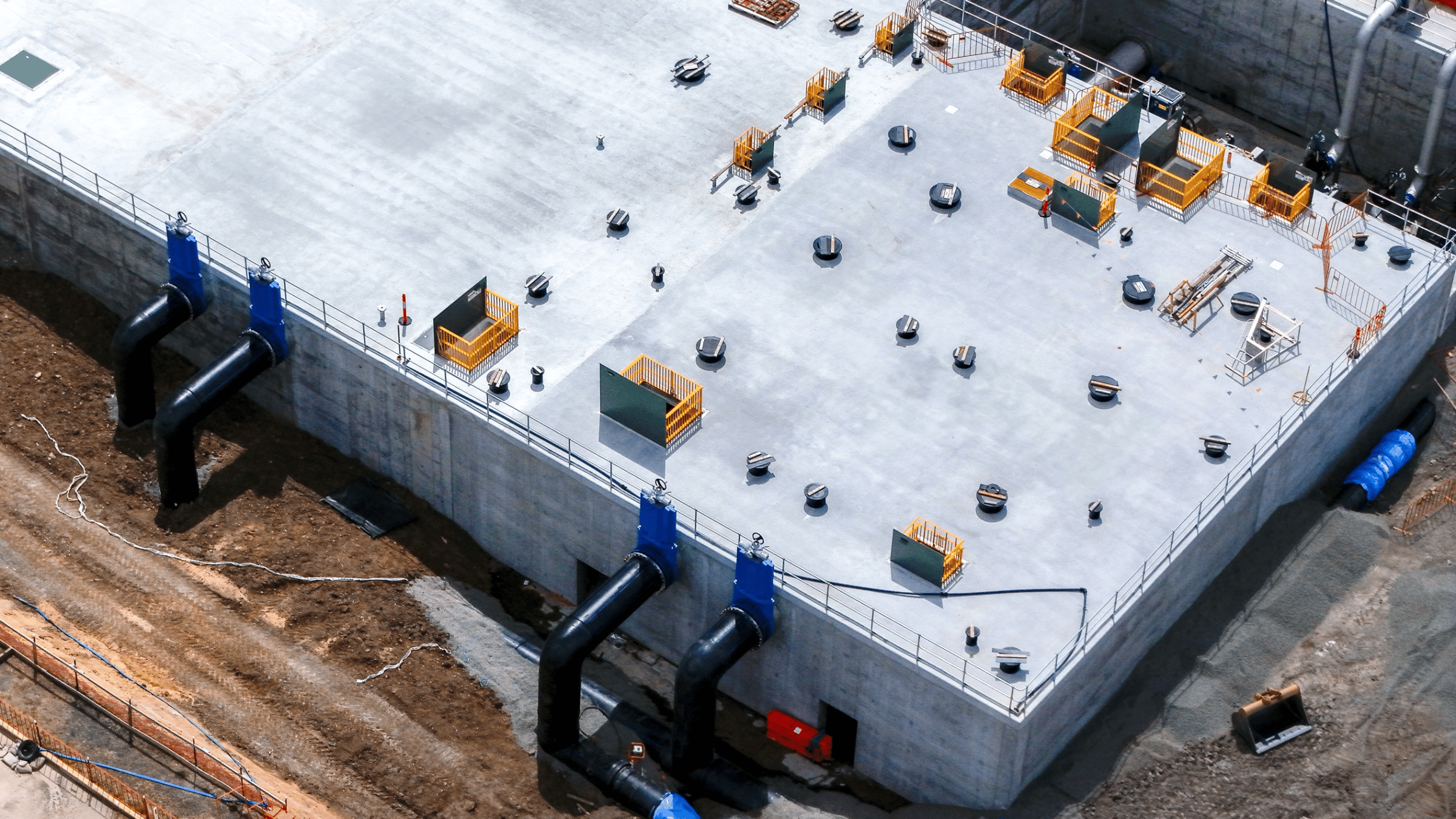
The 10-megalitre covered storage tank at Ti Tree Bend Wastewater Treatment Plant in Launceston, Tasmania - equivalent to four Olympic swimming pools - is now structurally complete.
Working carefully around legacy infrastructure while constructing this new water storage facility, our UGL CPB Joint Venture team is achieving a fine technical balance on the TERHAP Ti Tree Bend Covered Storage Project.
Delivered in partnership with TasWater as part of the Tamar Estuary River Health Action Plan, this milestone brings the project one step closer to achieving a core environmental objective - improving the health of the Kanamluka/Tamar estuary and the surrounding ecosystem.
On completion, the new network storage tank will minimise any waterwater overflows of untreated material into the estuary during high-level rain events.
Constructing the tank required more than 3,500 cubic metres of concrete and 750 tonnes of reinforcing steel, creating a robust, long-life asset designed to improve wastewater system resilience for northern Tasmania.
With the tank structure now complete, the project has transitioned into its final delivery phase.
"Current works are focused on connecting the tank into the existing network, including the installation of electrical, mechanical and civil infrastructure, more than 300 metres of new underground pipework, and new pumps, stainless-steel pipework and access platforms to support safe operation and maintenance," explains TasWater Alliance Program Manager Ian Dunbabin.
"A new switch room building has also been delivered and positioned on site, with cabling and monitoring systems now being installed."
To ensure performance and reliability, waterproof testing of the tank using treated effluent has now been successfully completed.
"This milestone has been achieved while working carefully around legacy infrastructure - some more than 140 years old - with support of local Tasmanian contractors and specialist trades."
With the tank structure in place, the project moves closer to operational readiness in early 2026.